How Long Does TMS Take? A Week-by-Week Treatment Timeline
Quick Answer: A standard course of TMS runs about six weeks of daily weekday sessions, followed by a taper over roughly two more weeks, for around 36 sessions in total. Each visit takes about 20 minutes of treatment time, and you are usually in and out in around half an hour. Most people don't feel much in the first week or two. When improvement comes, it tends to build gradually across the course rather than arriving all at once. Individual timelines vary, and TMS doesn't work for everyone.
When you're weighing up TMS, "how long does it take" is really two questions. How long is each appointment, and how many weeks until you actually feel better. They have different answers, and knowing both before you start makes the commitment far easier to plan around. Here's the full picture, week by week.
The short version: what the full course involves
A standard course of TMS for depression looks like this:
- About six weeks of sessions, five days a week, on weekdays
- A taper phase of a few sessions spread over roughly the two weeks after that
- Around 36 sessions in total
- About 20 minutes of treatment per session, and roughly 30 minutes in the chair from start to finish
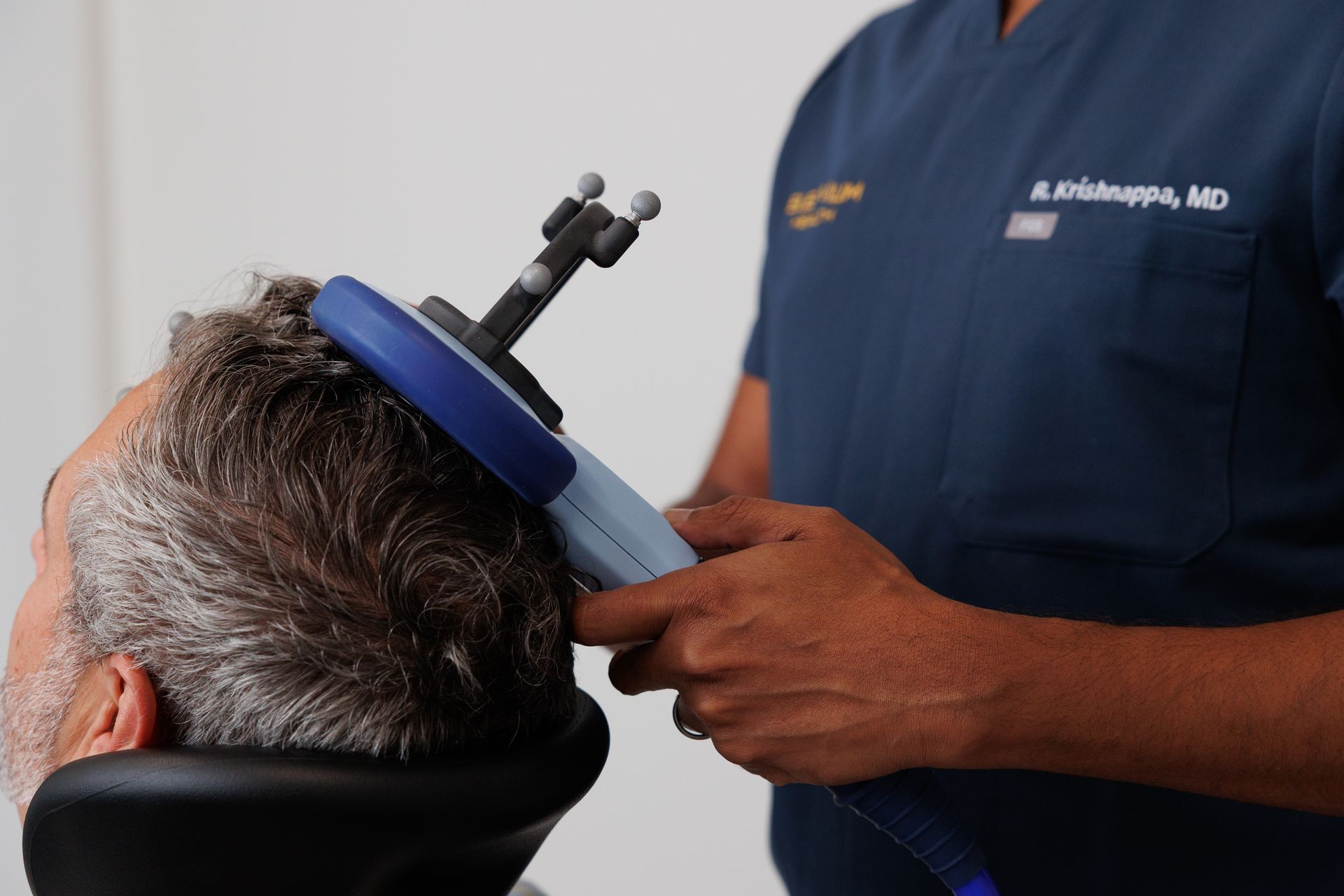
Each session itself is straightforward. You sit in a chair, awake, while the device delivers magnetic pulses to a targeted area of the brain. There's no anesthesia and no recovery time, so you can drive yourself home afterward and carry on with your day. Most people read, listen to music, or sit on their phone during the session.
That daily rhythm is the part worth planning for. The time in the chair is short, but five visits a week for six weeks is a real scheduling commitment, and it helps to sort out how it fits around work and life before you begin.
Week 1: Mapping and getting started
Your first visit is a little longer than the rest, because it includes the mapping session. Using neuronavigation, the system maps your individual brain structure, and one of our physicians confirms the treatment target (the dorsolateral prefrontal cortex, the region involved in mood regulation). That target is then tracked throughout every session that follows, so the pulses land in the same place each time.
After mapping, your daily sessions begin. In the first week it's common to feel some mild scalp discomfort or a light headache during or after a session. For most people these early effects settle within the first week as you get used to the sensation. What you most likely won't feel yet is any change in mood, and that's completely normal. The first week is about getting started and letting your body adjust, not about results.
Weeks 2 to 3: Settling into the routine
By the second and third weeks, the sessions become routine. The tapping sensation feels familiar, any early side effects have usually eased, and the appointments start to feel like a normal part of the day rather than something to brace for.
Most people still don't notice much shift in how they feel during this stretch, and that isn't a sign anything is wrong. TMS works gradually. The main thing happening in these weeks is consistency, which is exactly what the treatment needs to do its work.
Weeks 3 to 4: When some people start to notice
This is often the window where the first small changes show up, though it varies a lot from person to person. Some people begin to notice they're sleeping a little better, have slightly more energy, or feel marginally less weighed down. Often the people around you notice before you do.
It's worth being honest here: there's no guaranteed week when TMS "kicks in." Some people feel it earlier, some later, and some not at all. Throughout the course, your response is tracked using standardized measures rather than left to how you happen to feel on a hard day, which gives you and the clinical team a clearer read on whether it's working than memory alone would.
Weeks 5 to 6: Completing the acute phase
The fifth and sixth weeks complete the main daily block of treatment. For people who are responding, improvements are often more established by this point, though still building. For people who haven't noticed much yet, this is a natural moment for the clinician to review the plan and talk through whether to adjust the approach, extend treatment, or consider other options.
Finishing the acute phase is a milestone, but it usually isn't the end of treatment.
The taper: easing out over about two weeks
Rather than stopping abruptly after the acute phase, TMS steps down in frequency over roughly the next two weeks. Instead of daily sessions, you come in less often as the course winds down. This taper is designed to help consolidate the gains made during the main block rather than ending everything at once. Counting the taper, the full standard course comes to around 36 sessions.
After the course: what comes next
Once the course is finished, what happens next depends on how you responded.
Some people need nothing further and simply carry on. For others, the clinician may discuss booster or maintenance sessions down the line, particularly if symptoms start to creep back later. It's also worth knowing that for some people, improvement continues to build in the weeks after the final session rather than stopping the moment treatment ends.
And if TMS didn't help enough, that's a real outcome too, not a failure on your part. Response varies between individuals, and there are other treatment paths to consider from there. A good clinician will be straight with you about where things stand and what the sensible next step is.
Faster timelines: accelerated options
Accelerated TMS compresses a full course into about five days, with multiple sessions per day across a single week. It's a bigger daily commitment over a much shorter window, and it may not be covered by insurance, which is confirmed up front. There's also a One-Day TMS option that delivers a course in a single supervised day. This is an investigational protocol and is not covered by insurance.
Which format makes sense depends on your situation, your timeline, and what you're able to commit to, and it's one of the things an evaluation is designed to sort out.
Frequently Asked Questions
How long is each TMS session?
About 20 minutes of actual treatment, with a little time either side, so you're usually in and out in around half an hour. The first session runs longer because it includes the mapping step.
How many weeks until TMS starts working?
It varies. Many people don't notice change in the first couple of weeks, and when improvement does come it tends to build gradually, often becoming noticeable somewhere a few weeks in. Some people feel it later, including after the course ends, and it doesn't work for everyone.
Do I have to go every weekday?
A standard course is five sessions a week for about six weeks, so yes, the acute phase is a daily weekday commitment. If that schedule is hard to manage, it's worth asking about accelerated formats that compress treatment into a shorter window.
What happens if I miss a session?
The occasional missed session is usually manageable and can be made up, but consistency matters for results, so the aim is to keep to the schedule as closely as you can. If something comes up, let the team know and they'll help you work it out.
Share Article